Science is a marvelous adventure of curiosity, observation, and discovery. At Key Stage 2 (KS2), children step into the boots of real scientists, asking big questions about how animals adapt, why plants need light, and what makes forces push and pull.
Developing a strong scientific foundation during these formative years builds critical thinking skills that pay dividends across all subjects.
At Shiraz Academy, we believe that learning science should be an exciting, hands-on experience that sparks lifelong curiosity. When young learners discover how to form hypotheses, conduct fair tests, and analyze their results early on, academic confidence naturally soars. In this guide, we are going to teach you simple, practical steps to make KS2 science interactive and fun right at home today!
Why Primary Science Education Matters for Future Success
Engaging with fundamental scientific concepts early in primary school does far more than prepare pupils for national assessments; it trains the young mind to evaluate information logically.
For primary school students, understanding the scientific method strengthens mathematical reasoning, reading comprehension, and problem-solving resilience. You can explore primary science curriculum standards and educational framework guidance through the Association for Science Education (ASE) primary resources.
Step-by-Step Guide: How to Explore KS2 Science at Home
You do not need a fully equipped laboratory to explore key national curriculum topics like forces, habitats, and materials. Simple everyday household items are perfect for interactive experiments. Follow these simple steps:
1. Investigating Friction with the Toy Car Surface Test
- How to do it: Build a small ramp using a hardback book or cardboard. Roll a small toy car down the ramp onto different household surfaces—such as smooth wood, a fluffy carpet, and aluminum foil—and measure how far the car travels on each surface using a ruler.
- The Benefit: This simple experiment brings the concept of friction to life, demonstrating how rougher textures create opposing force and slow objects down.
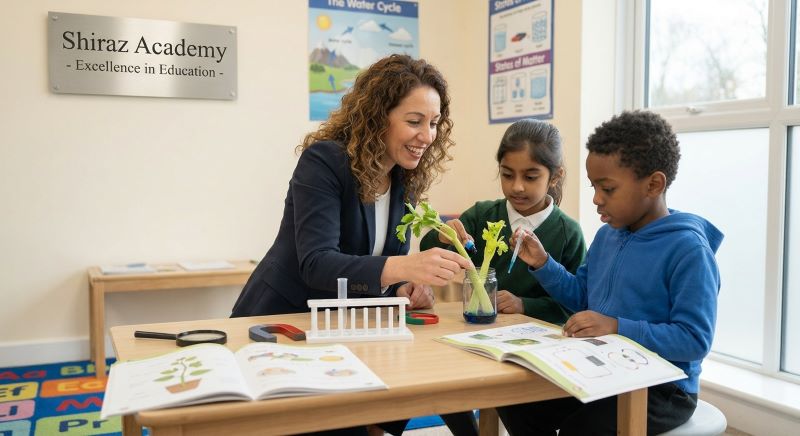
2. Exploring Plant Transport (Xylem) with Celery and Food Coloring
- How to do it: Fill a glass jar halfway with water and stir in several drops of dark blue or red food coloring. Place a fresh celery stalk with leaves into the jar and observe it over 24 hours to watch the colored water travel up through the stem into the leaves.
- The Benefit: This classic visual demonstration clearly reveals how plants transport water and nutrients from their roots up to their leaves. You can read more about foundational learning structures in our previous guide on Persian Language Classes.
3. Understanding States of Matter with Freezing and Melting Experiments
- How to do it: Freeze small plastic items inside ice cubes. Give your child different safe tools—such as warm water droplets, table salt, or a magnifying glass—to test which method melts the ice fastest and releases the item.
- The Benefit: Hands-on manipulation helps pupils grasp how heat energy changes solids into liquids in a memorable, playful way.
Tips for Nurturing Scientific Curiosity Everyday
- Ask Open-Ended “Why” and “How” Questions: Whenever your child notices something unusual in nature, encourage them to guess what might be happening before giving them the answer.
- Keep a Science Discovery Journal: Provide a small notebook where your child can draw diagrams, record test measurements, and paste leaf rubbings.
- Embrace Mistakes as Learning Moments: In science, an unexpected test result is never a failure; it is simply new data that leads to exciting new questions.
Boost Academic Excellence with Professional Tuition at Shiraz Academy
Mastering core curriculum science, maths, and English is deeply rewarding when young learners have supportive, expert tutors guiding their journey. Whether your child needs extra help preparing for school tests or wants to extend their academic potential, our primary specialists are here to help them shine.
We offer warm, encouraging classes in person at our dedicated education centre in Cradley Heath, sessions covering Birmingham, and interactive online tuition. To check available times and secure your place, visit the Shiraz Academy Contact Page today and start your child’s journey toward scientific mastery!